For MCST councils, property managers, and business owners, knowing which type fits a given site is the first step towards engaging the right security guard and avoiding the cost of a mismatched deployment.
What are the Different Types of Security Guards?
Security guards are deployed in a range of specialised roles, each designed to address specific operational needs across different environments.
1. Unarmed Security Guards
Unarmed security officers make up the majority of licensed personnel. They handle day-to-day security functions such as access control at entry points, scheduled patrols, incident response, and, where required, monitoring surveillance systems.
- Licensing requirement: Police Licensing & Regulatory Department (PLRD) Security Officer Licence plus Workforce Skills Qualifications (WSQ) certified Basic Licensing Units in Guard and Patrol, Incident Response, and Threat Observation.
- Typical deployments: Offices, condominiums, factories, warehouses, educational institutions, and healthcare facilities.
Shine Security’s licensed security guard service deploys PLRD-licensed and WSQ-certified unarmed officers trained in access control, patrols, and incident response across residential, commercial, and industrial sites.
2. Armed Security Guards
Armed security is not a standard type of private security guard deployment.
- Regulatory basis: It is primarily undertaken by Auxiliary Police Officers (APOs) authorised by the Singapore Police Force to carry firearms for high-security duties.
- Typical scope: Armed security is limited to high-risk environments and critical functions such as protecting key infrastructure (airports, ports, and sensitive installations), armed cash-in-transit escorts, VIP protection, and custody escorts for persons in detention or transfer.
While APOs may also perform broader duties such as crowd and traffic management or immigration-related screening, armed security deployments specifically refer to their firearms-authorised, high-risk protection role.
3. Corporate Security Guards
Corporate security officers work in office buildings, business parks, and corporate campuses. Their work blends traditional security functions with front-of-house professionalism, particularly in premium commercial environments where the officer is often the first person a visitor interacts with.
- Typical duties: Lobby and reception management, visitor and contractor access control, surveillance monitoring, and enforcement of building protocols.
- Defining trait: Dual-function presence; officers must be both vigilant and presentable, representing the property’s brand.
For high-end corporate environments, we provide concierge security services where our licensed officers combine strict access control with a professional front-of-house presence aligned with the property’s standards.
4. Retail Security Guards
Retail security officers, often called loss prevention officers, work in shopping malls, department stores, and high-traffic retail spaces. The environment is fluid and public-facing, and the work demands constant situational awareness rather than control of a fixed access point.
- Typical duties: Shoplifting deterrence, CCTV monitoring, apprehension and de-escalation protocols, and coordination with mall management.
- Additional function: Crowd management during peak periods, festive sales, and promotional launches.
In retail environments, deployment typically involves a mix of visible, uniformed officers for deterrence and plainclothes loss prevention operatives who work discreetly to monitor behaviour without alerting subjects.
5. Residential Security Officers
Residential officers work in condominiums, gated communities, and mixed-use developments. Condominium deployments are particularly tied to MCST-governed estates, where the security contract is held by the managing agent and requires council approval.
- Typical duties: Guardhouse access control, visitor and delivery screening, common-area patrols, and resident incident response.
- Defining trait: Security rigour combined with resident-facing professionalism; officers manage access decisively while maintaining a courteous, community-appropriate presence.
This type of security deployment is most effective when the guard balances strict access control with a visible, professional presence that supports day-to-day community safety and resident confidence.
6. Mobile Patrol Officers
Mobile patrol officers conduct vehicle-based security patrols across large sites or multiple locations. The model provides visible deterrence across wide perimeters and enables rapid response to alerts flagged by static guards, residents, or remote monitoring systems.
- Typical duties: Scheduled and randomised vehicle patrols, perimeter checks, alarm response, and inter-site support.
- Best-fit environments: Industrial estates, logistics parks, construction zones, and multi-building campuses where static guarding at every point is impractical.
Mobile patrol operations are often integrated with static guarding and CCTV monitoring, ensuring continuous coverage by bridging gaps between fixed posts and enhancing overall site security visibility.
7. Event Security Guards
An event security guard is a licensed officer trained specifically for high-traffic events within fixed operational windows: managing crowd flow, access screening, emergency response, and VIP protection in a single deployment cycle.
- Planning element: Pre-event risk assessment, site walk-throughs, and contingency protocols agreed with the organiser.
- Common settings: Convention centres, stadiums, hotels, corporate offices, and outdoor public venues.
Our event security service covers diverse crowd dynamics, from closed-door corporate AGMs to large outdoor public events, supported by an AI-powered command centre oversight.
8. Close Protection Officers
Close protection officers, commonly known as bodyguards, provide personal security to individuals at elevated or specific risk. Close protection goes well beyond static guarding and calls for rapid independent judgement in unpredictable settings.
- Typical duties: Advance route and venue assessment, close-in personal protection, coordination with other security teams, and access management in public settings.
- Specialised skillsets: Defensive driving, threat recognition, public-facing composure, and emergency medical response.
Shine Security’s escort security service provides secure transit protection for high-value assets and personnel, supported by structured protocols for local and specialised assignments, ensuring safe, controlled movement.
9. Surveillance Officers
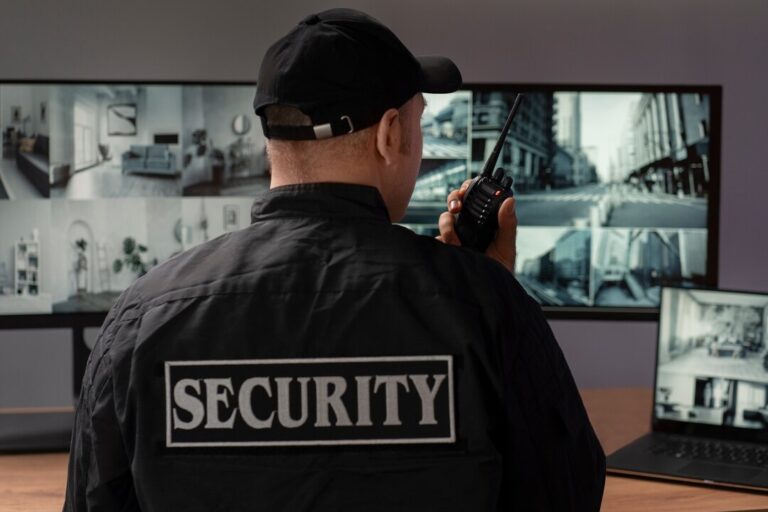
Surveillance officers, also known as CCTV operators, are a specialised type of security personnel responsible for monitoring security camera systems and are distinct from on-ground guarding roles.
- Typical duties: Multi-feed live monitoring, anomaly detection, alarm verification, incident escalation, and post-incident video retrieval.
- Critical distinction: Passive recording captures incidents after the fact; active monitoring allows a trained operator to intervene in real time.
Our remote CCTV surveillance service combines AI-powered video analytics with 24/7 human monitoring from the command centre, coordinating immediate on-ground response when a threat is confirmed.
10. Industrial and Construction Site Guards
Industrial and construction site guards secure warehouses, factories, ports, logistics hubs, and active construction zones. These sites typically have large perimeters, high-value equipment, significant after-hours exposure, and routine access by contractors, vehicles, and heavy machinery.
- Typical duties: Perimeter patrols, contractor and vehicle access logging, materials tracking, and after-hours monitoring.
- Site-specific training: Hazard awareness, PPE compliance, and coordination with appointed safety officers on live construction or industrial sites.
11. Fire Safety Watch Officers
Fire watch officers operate during windows when a site’s fire detection or suppression systems are offline or under maintenance, or when high-risk activities such as hot work or welding are in progress. Fire watch is a time-bound specialist function rather than a permanent security posting.
- Regulatory context: Fire safety is governed by the Singapore Civil Defence Force (SCDF); fire watch may form part of a site’s broader safety plan under the appointed safety officer.
- Typical duties: Continuous patrols of the at-risk zone, monitoring for ignition sources, immediate escalation, and first-response fire suppression, where trained to do so.
Key Distinctions of Security Guard Deployment to Understand Before Hiring
Beyond the individual types of security guards, three broader distinctions shape how site security is structured in practice.
Contract Security vs In-House Security
Contract security, where officers are sourced from a licensed agency, is the dominant model in Singapore. The agency handles recruitment, training, licensing, and PLRD compliance, shifting regulatory exposure away from the client organisation.
In-house security, where officers are directly employed by the property or company, provides tighter operational control but places the full burden of compliance, training, and workforce management on the employer.
Uniformed vs Plainclothes Officers
Uniformed officers deliver a visible deterrent: their presence signals active security to members of the public and potential offenders alike.
Plainclothes officers, common in retail loss prevention and certain VIP assignments, operate covertly to observe behaviour without alerting subjects. Most environments benefit from one mode; some high-risk retail or event settings combine both.
Static vs Mobile Deployment
Static officers hold a fixed post, such as a lobby, guardhouse, reception desk, or access checkpoint.
Mobile patrol teams cover wider areas on scheduled or randomised rounds, by vehicle or on foot. Professional deployments frequently combine both, closing the coverage gaps each mode creates on its own.
Finding the Ideal Type of Security Guard for Your Property

The right security deployment depends on the environment, the site’s risk profile, and its operational requirements.
No single category covers every scenario, and a reputable A-Grade licensed agency such as Shine Security will assess the site before recommending a deployment model, rather than matching a security guard solely based on cost or availability.
If you’re looking to hire a professional security guard matched to your site’s risk profile and operational demands, speak to our team for a site assessment.