Physical security and cyber security are no longer separate budgets or separate problems for a Singapore business. A stolen access card, an unlocked server room, or an unattended visitor badge can lead to the exact same data breach as a phishing email, which is why companies that treat these as two departments with two priorities tend to end up with a gap somewhere in the middle.
Shine Security works across both sides of this, from on-site guarding and CCTV to IT security services, on the basis that a business only needs one weak point to have a bad year.
What Is the Difference Between Physical Security and Cyber Security
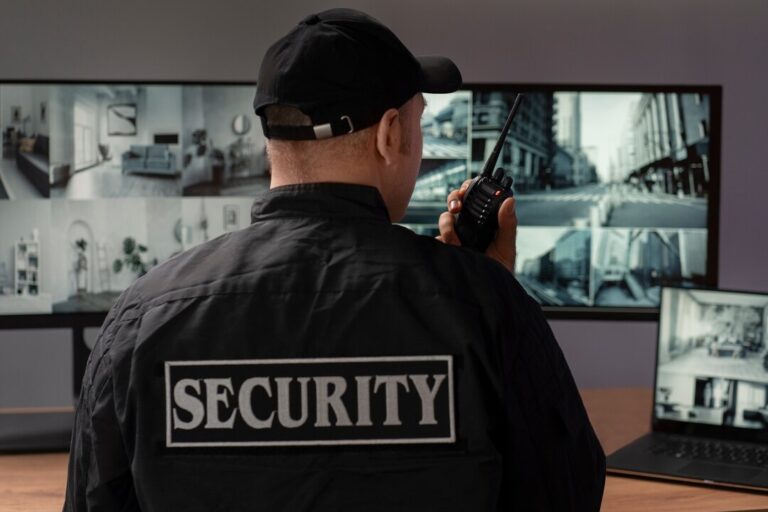
Physical security covers anything that stops a person from getting somewhere or taking something in the real world: guards, locks, CCTV, access control, alarm response. Cyber security covers the digital equivalent: firewalls, endpoint protection, network monitoring, incident response for breaches that happen through a screen rather than a door. The distinction sounds clean until an actual incident happens, because most serious breaches in Singapore involve some combination of both. A contractor who walks into an unguarded server room and plugs in a USB drive has just caused a cyber incident using a physical security failure, and neither team owns that problem on its own.
Why Do Singapore Businesses Need Both Physical and Cyber Security
A company that spends heavily on firewalls and endpoint software but leaves its office unlocked after hours, or vice versa, is optimizing half a problem. The Cyber Security Agency of Singapore has flagged ransomware and business email compromise as the two most reported threats to local organizations in its Singapore Cyber Landscape reports, and a good number of these incidents trace back to stolen credentials or unauthorized physical access to a workstation, not just external hacking. A few reasons the split doesn’t hold up in practice:
- Access badges, visitor logs, and server room entry are security data, not just building management, and a compromised badge system is a direct path to a compromised network
- CCTV footage is often the fastest way to work out how an internal breach happened, since digital logs alone rarely show who was physically at a machine
- Insurance and compliance audits increasingly ask about both sides together, particularly for firms handling financial or healthcare data under Singapore’s PDPA
- A single vendor managing both means one incident report and one point of accountability instead of two teams arguing over whose failure caused what
Splitting the two into separate contracts with separate vendors usually means nobody is responsible for the seam between them.
How Much Does Combined Physical and Cyber Security Cost for a Singapore Smb
Pricing varies more by headcount and site count than by industry, and most Singapore providers quote separately for guarding, CCTV installation, and managed IT security rather than a single bundled number. Manned guarding in Singapore commonly runs in the range of S$15 to S$25 per hour per officer depending on shift and location, while managed cyber security services for a small or mid-sized business typically start somewhere in the low thousands of dollars per month depending on the number of endpoints and whether monitoring is 24/7. A business with under 50 staff and a single office location will pay meaningfully less than a multi-site operation with remote workers accessing systems from outside a controlled network, since remote access itself expands what needs monitoring.
What Does a Cyber Security Agency of Singapore Actually Regulate
The Cyber Security Agency of Singapore, usually shortened to CSA, is the government body responsible for national cyber security strategy, critical infrastructure protection, and public guidance for businesses and individuals. It runs the Cybersecurity Labelling Scheme for smart devices, publishes the annual Singapore Cyber Landscape report, and coordinates incident response for nationally significant breaches, but it does not itself provide commercial security services to individual companies. That distinction matters because a private firm describing itself as a cyber security agency of Singapore is operating in the commercial market CSA regulates and advises on, not acting as an arm of CSA itself. Businesses looking for hands-on protection, whether that’s penetration testing, managed detection, or physical guarding, need a commercial provider, with CSA’s public advisories serving as the baseline standard most reputable providers align their practices to.
How Do Physical and Cyber Security Work Together at Coworking and Office Buildings in Singapore
Singapore’s density of coworking spaces and shared office buildings, concentrated around the CBD, Tanjong Pagar, and one-north, creates a specific overlap problem: multiple tenants sharing entry points, shared Wi-Fi infrastructure, and visitor traffic that no single company fully controls. A breach at one tenant’s network can sometimes reach another’s if the building’s physical access controls and network segmentation aren’t both handled properly. This is where a single provider covering guarding, access control, and network security tends to catch things that two separate vendors miss, since the same team can flag that a shared server closet has no card access logging at the same time it’s auditing firewall rules.
What Do Reviews and Industry Sources Say About Combined Security Providers in Singapore
Independent coverage of Singapore’s security sector tends to point the same direction: businesses are increasingly buying integrated packages rather than separate physical and IT vendors. TheBestInSG’s directory of security service providers lists firms offering combined guarding and cyber offerings as a distinct and growing category rather than a niche. Industry commentary from sources like the Cyber Security Agency of Singapore’s advisories consistently frames physical access control as part of an organization’s overall cyber hygiene, not a separate discipline, and business content creators connected through platforms like GetMyInfluencer have picked up on this shift as more Singapore SMEs discuss security spend publicly. For comparisons of service providers across the region, TheBestIn.World tracks similar supplier roundups city by city.
Why Choose Shine Security
Shine Security runs guarding, CCTV, and IT security services under one team rather than splitting a client across separate vendors for the physical and digital sides of the same building. That structure matters most during an actual incident, when figuring out whether a breach started with a stolen badge or a compromised login shouldn’t depend on two companies comparing notes after the fact. A single point of accountability for both sides of security is still uncommon enough in Singapore’s market to be worth asking about directly when comparing providers.
Conclusion
Treating physical and cyber security as two separate line items made more sense when the two rarely intersected. That’s no longer the case for most Singapore businesses, particularly ones operating out of shared office buildings or handling remote access to internal systems, where a gap on one side becomes a problem on the other side within hours. The Cyber Security Agency of Singapore’s own reporting backs this up year after year, and it’s rarely the businesses with the biggest security budgets that get caught out, it’s the ones with a blind spot at the seam between guarding and IT.
Get in touch with Shine Security today and find out where that seam might already be open!